
Wusseken
Mecklenburg-Vorpommern
Our “Rewilding Wusseken” project was recognised as part of the UN Decade on Ecosystem Restoration.
Learn more about the award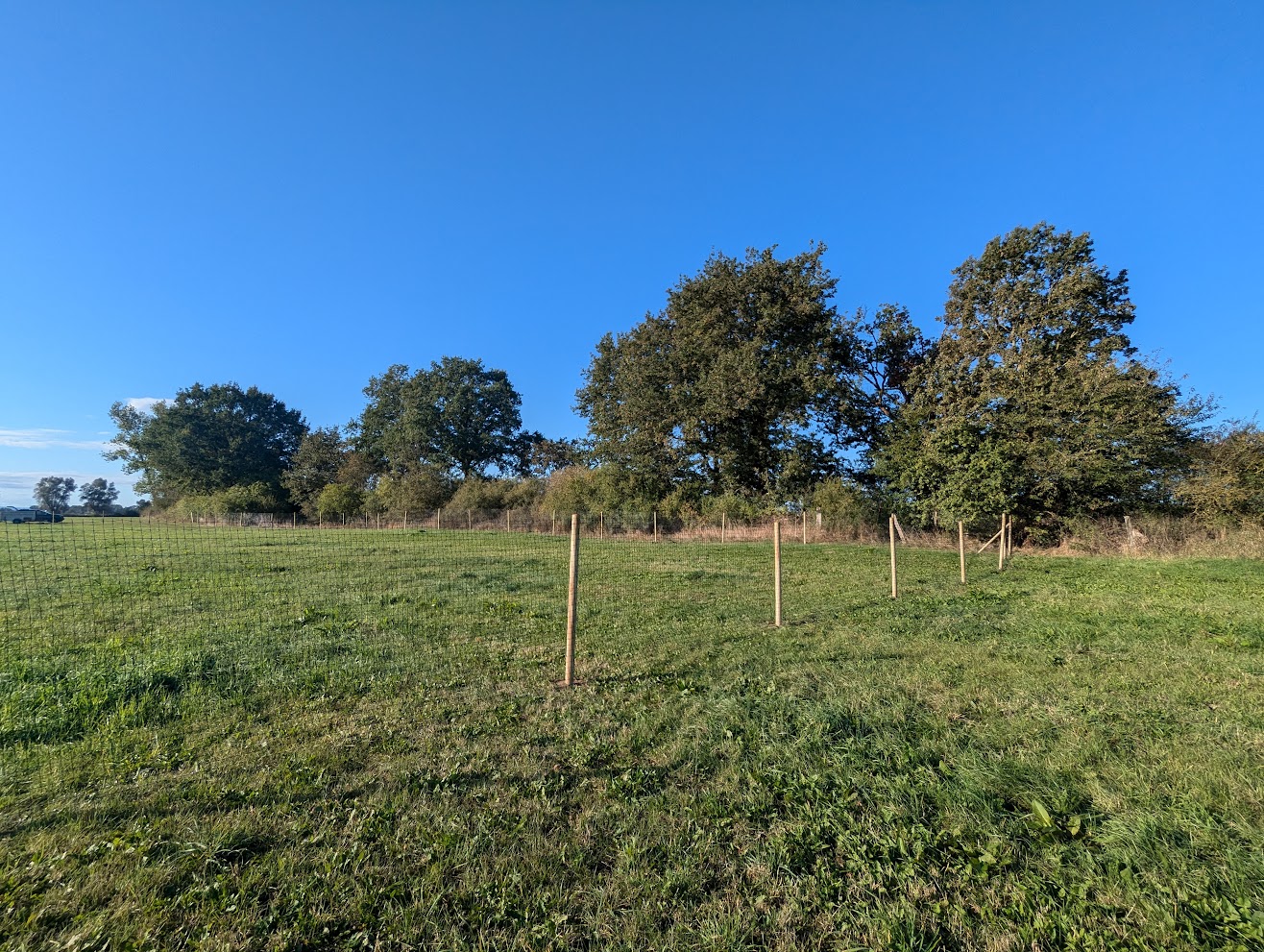
Our Rewilding Area Near Wusseken
eMission-X owns a total of 8,250 m² of natural land near Wusseken in Mecklenburg-Western Pomerania.
What makes this project special is the diversity found within a relatively small area. Our properties include bodies of water, former farmland, and an existing field hedge.
We therefore manage each area differently.
Where near-natural structures already exist, we largely leave them undisturbed. In areas that were previously intensively farmed, however, we support the initial phase of natural development through targeted initial renaturation.
From Farmland Back to Nature
Agricultural use was discontinued on approximately 3,800 m², and an initial phase of restoration was begun.
There, we have planted tree and shrub species suited to the site, thereby creating initial structures from which the area can subsequently develop as independently as possible.
The planted trees and shrubs include, among others, English oak, mountain ash, medlar, service tree, wild pear, wild apple, hazel, bird cherry, and white birch.
These plantings are not intended to become a commercial forest.
Rather, they are intended to support the development of a more diverse vegetation structure. In the long term, nature itself will increasingly determine which plants establish themselves on the site and how the property changes.
Initial renaturation does not require ongoing maintenance
During the initial development phase, we monitor the planted trees and shrubs to ensure they are not completely overgrown by competing vegetation.
However, this support is intentionally limited in time.
Our goal is not to permanently maintain a specific landscape condition. Once the young trees and shrubs have established themselves, natural processes should increasingly take over further development.
Give nature a nudge—and then let it take over.
Water bodies remain water bodies
Our property complex also includes water bodies and their surrounding areas.
No plantings or major interventions are planned here unless they are necessary from an ecological standpoint.
The existing water bodies and shoreline structures should be allowed to develop as independently as possible.
This makes these areas distinctly different from the former farmland: for us, rewilding does not mean doing the same thing everywhere, but rather responding to the specific conditions of each area.
The field hedge will be preserved
Another feature of the property is an existing field hedge.
In agricultural landscapes, hedgerows and woody structures can provide food, cover, and refuge for numerous animal species.
Therefore, there is no reason to fundamentally alter the existing structure here.
The field hedge will be preserved and can continue to develop alongside the adjacent areas.
Rewilding on Different Starting Areas
Wusseken illustrates particularly well how differently rewilding can look even within a single project:
On the former farmland, we are initially supporting the development through plantings.
We are largely leaving the existing field hedge in place to allow it to continue developing.
The water bodies, on the other hand, require a different approach and are left as undisturbed as possible.
What connects these different areas is our shared goal:
Economic use comes to an end, and natural processes are given more room to thrive again.
Permanently preserved for nature
The total area of 8,250 m² will remain the property of eMission-X and will be permanently removed from commercial use.
Once the necessary initial restoration is complete, human influence on the area’s further development will be gradually reduced.
As a result, a natural area will emerge near Wusseken—comprising bodies of water, open land, woodlands, and field hedgerows—whose future development will increasingly be shaped by natural processes.
Activities
Observations, restoration activities and changes documented with dates and photographs.
No activities have been published for this property yet.
Help create more wilderness.
Your support helps us permanently protect more land for nature in Germany.