
Klein Breesen (Moor)
Mecklenburg-Vorpommern
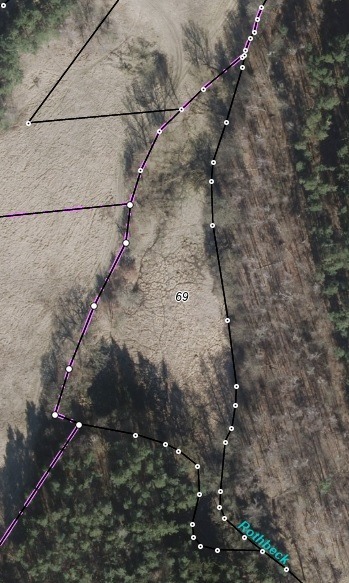
8,600 m² of protected bog and spring habitat
Location: Klein Breesen near Zehna, Mecklenburg-Western
Pomerania Habitat: Marsh and spring biotope
Size: 8,600 m²
Protection status: Legally protected biotope
Water body: Rotbek
Rewilding: Improving the natural water balance with the goal of retaining
more water in the marsh Status: Permanently secured; measures for water retention are being studied and implemented
Our bog near Klein Breesen
eMission-X owns an 8,600 m² bog and wetland area near Klein Breesen in Mecklenburg-Western Pomerania.
The property is a legally protected biotope and is traversed by the Rotbek, a small stream.
The area consists of various moist and wet habitats. The following, among others, are documented in the biotope profile:
- Marsh sedge meadow
- Brownroot-sedge spring meadow
- Tall forb communities
- Natural small bodies of water with duckweed
- Alder riparian woodlands

lesson’s water frog
(Pelophylax lessonae)
The soil consists largely of moist to occasionally waterlogged peat.
Retaining water in the bog
One thing is crucial for the long-term development of a bog: water.
That is why our rewilding project in Klein Breesen is not about planting trees or regularly maintaining the area. Our goal is to improve the bog’s water balance and retain as much water as possible within the area.
To this end, we are studying the hydrological conditions and evaluating which measures can improve natural water retention.
We intend to intervene only where it is sensible and necessary for the bog’s development. Afterward, the area should continue to develop with as little human intervention as possible.
A Dam to Retain More Water in the Marsh
One concrete step is water retention via a dam, which is intended to reduce the rapid runoff of water from parts of the bog.
Our goal is to ensure that water remains in the area longer and to support the wet site conditions of the bog habitat.
We plan to monitor and document how the water level and vegetation develop over the long term.


The Bog as a Habitat and Carbon Store
Bog soils can store large amounts of carbon. A consistently high water level is crucial for this: if peat is drained and aerated, stored carbon can be released again.
Protecting the water balance is therefore important not only for the typical bog vegetation but also for the long-term preservation of the carbon stored in the peat soil.
At the same time, the area provides a habitat for plants and animals adapted to wet conditions.
Documented species include, for example, marsh sedges, irises, duckweed, and alder riparian woodlands.
Rewilding here means: retaining water and then letting nature take its course
Klein Breesen illustrates particularly well that rewilding does not mean the same thing for every area.
On some of our properties, it is sufficient to cease commercial use. On other areas, we first plant woody plants suited to the site.
At our bog in Klein Breesen, however, the focus is on the water balance.
Our goal is to improve the conditions for the moorland habitat to develop as naturally as possible and then intervene as little as possible.
Permanently preserved for nature
The 8,600 m² bog area remains the property of eMission-X and is permanently removed from commercial use.
There are no plans for agricultural or forestry use, nor for the commercial exploitation of the area.
In this way, we permanently safeguard a unique bog and wetland habitat and give natural processes more room to thrive once again.
The biotope profile for our bog area
The official biotope profile for our moorland area
The special significance of the area is officially documented in the biotope profile. Biotope Profile No. 4005 describes the habitats and vegetation structures recorded on our peatland near Klein Breesen. Among other things, it mentions the presence of marsh sedge meadows, spring areas, tall forb communities, small bodies of water, and alder thickets.
The biotope profile thus documents the initial condition of the area and serves as an important basis for us to track the bog’s long-term development.
You can view the official biotope profile (PDF) No. 4005 for our bog area directly here:
🔗 http://www.emission-x.eco/wp-content/uploads/2025/11/Zehna-Biotop.pdf


Activities
Observations, restoration activities and changes documented with dates and photographs.
No activities have been published for this property yet.
Help create more wilderness.
Your support helps us permanently protect more land for nature in Germany.