
Three sows, many piglets, and an old loner
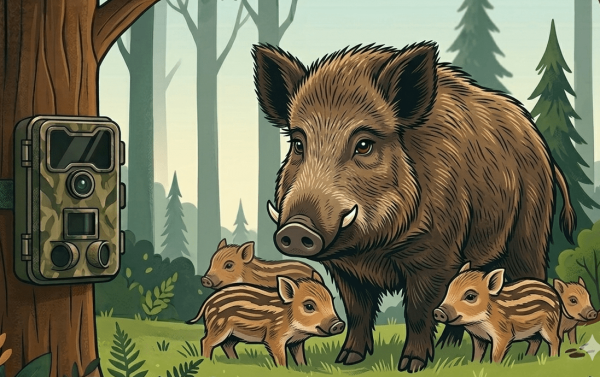
Sometimes pictures reveal more about the state of an ecosystem than any statistic. In recent weeks, we at eMission-X have made several remarkable observations on our land. Our camera captured wild boars with their young on our property, including three sows, many piglets, and an old loner.
A spotted sow with her young
We’ll start with an animal with a particularly distinctive coat. It’s a spotted sow who was out and about with her piglets. Her striking coat pattern makes her unmistakable and shows just how diverse nature can be. The piglets stayed close to their mother at all times while they attentively explored their surroundings and searched for food.
Observations like these are a wonderful sign that the animals are finding sufficient cover, peace, and food on our lands.
A second sow with her young on a discovery tour
Another sow with young piglets can be seen. The young follow their mother in single file through the vegetation, getting to know their surroundings along the way. In the first weeks of life, the young are still particularly dependent on their mother’s protection and experience.
For us, such images are an indication that these areas serve as suitable refuges for wildlife and play an important role in supporting local biodiversity.
Family Life in Hiding
The third sow was also spotted with several piglets. Although wild boars are often perceived as a common species, much of their family life remains invisible to humans. This makes it all the more exciting to gain insights into these social structures.
The sows care intensively for their young and defend them resolutely against potential dangers. The piglets grow quickly but remain closely bonded to their mother for many months.
The Loner
A little later, our camera captured a solitary wild boar. It is likely an older boar traveling outside of family groups. Such animals often lead much more reclusive lives and cover greater distances than sows with their young.
Our areas are therefore not only important for raising young animals but are also used as habitat by adult animals.
What These Observations Mean for Our Work
Every sighting—including the wild boars with their young on our lands—confirms how important undisturbed refuges are for all wildlife.
Where nature can develop largely free from human interference, habitats emerge for numerous species—from insects to wild boars.
Our task in this regard is very simple. We must permanently secure these areas, return them to nature, and give nature the time it needs to develop on its own.
Because sometimes nature conservation isn’t what people do—it’s what they consciously choose not to do!