
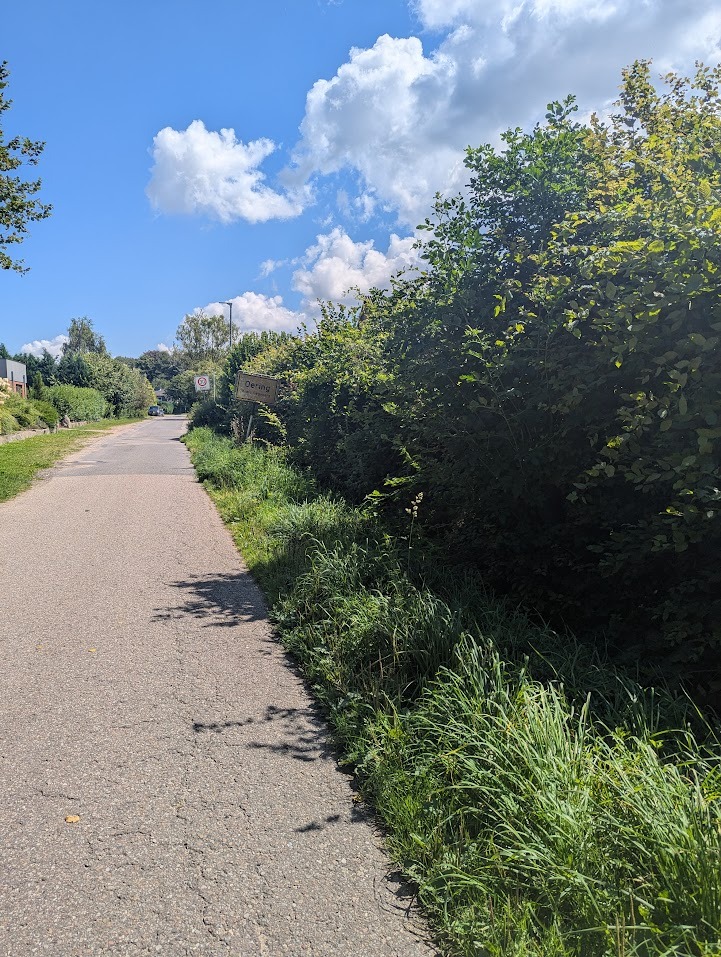
What is a "Knick"?
In agriculture, a “Knick” (also known regionally as a “Wallhecke”) is a typical type of earthen embankment hedge, particularly common in northern Germany (e.g., in Schleswig-Holstein). It consists of an earthen embankment about one meter high that is densely overgrown with native tree and shrub species.
The modern practice of “cutting back to the stump” is a distortion of the original concept of the knick. In fact, the trees and shrubs along the knick are split at the base and then laid flat parallel to the knick. This creates a natural protective barrier.
The Current State of the Knick
Farmers today cut down the hedgerows; larger pieces of wood are sold as firewood, and the rest is burned. This cannot be in the interest of nature conservation.
The destruction of the knicks began at the end of the 19th century. Between 1956 and 1970, approximately 70–80% of all knicks were destroyed as a result of land consolidation.
Hermann Löns—Reflections on the Hedgerow
Hermann Löns wrote the following poem on this subject around the turn of the century.
Land Consolidation
A man walks through the colorful countryside;
He holds a measuring chain in his hand.
He looks ahead and looks around;
“Everything here is crooked and twisted!”
He measures this way and that;
“Everything here goes all over the place!”
He looks down at the stream in the valley;
“That thicket over there makes no sense!”
He points to the pond;
“That’ll make a patch of potato field!”
The path pains his eyes;
“From now on, it must be dead straight!”
The hedge strikes him as a horror;
“We’ll clear it out, of course!”
The wild pear tree is too crooked for him;
“We’ll chop that one down first!”
The poplar seems pointless to him;
“It must go, of course!”
And so, with great ingenuity
, a great deal of farmland is thoroughly ruined.