
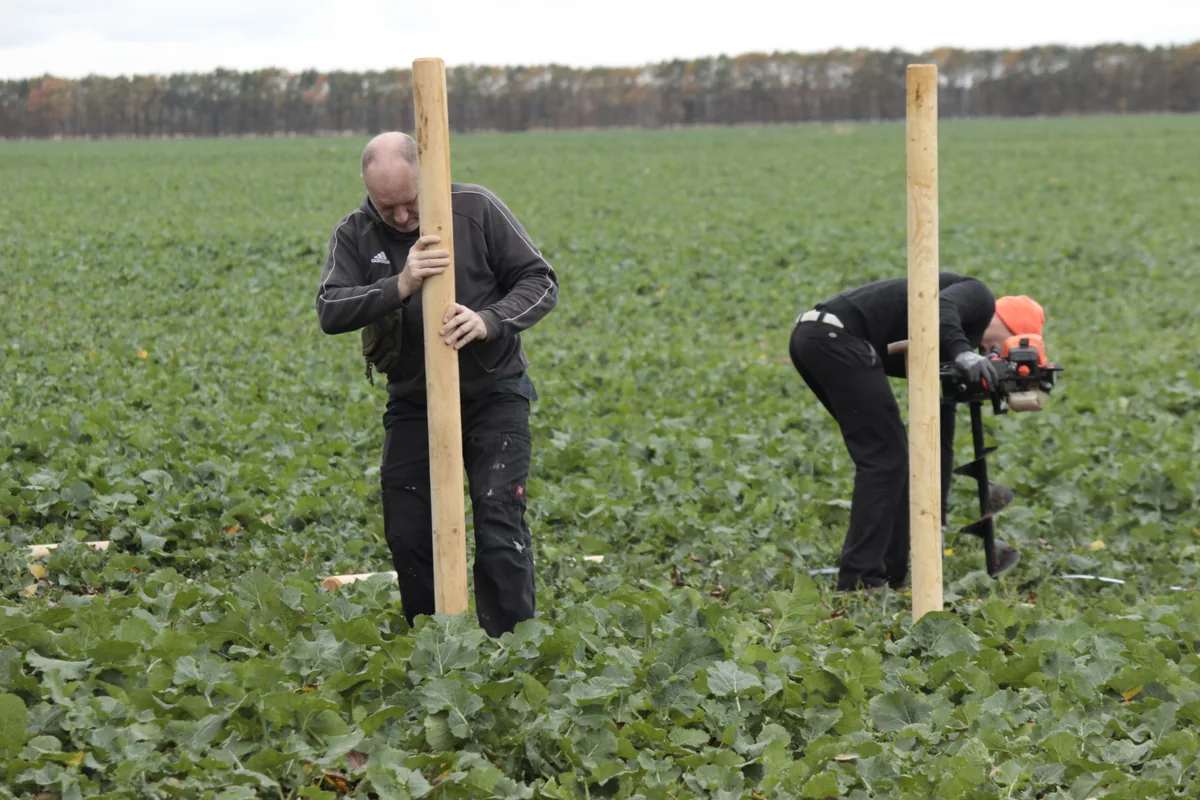
Planting Event on November 1, 2026 – Mecklenburg-Western Pomerania
Sometimes it doesn’t take much to give nature a new chance. A small piece of land, a few young trees and shrubs, people willing to lend a hand—and, above all, the certainty that this area will be left to develop naturally for the long term.
On November 1, 2026, we were back at our property in Kückenshagen, Mecklenburg-Western Pomerania. By planting 26 new trees and shrubs of seven different species, we took another step toward promoting ecological diversity on the site.
A small property with unique challenges
Our property in Kückenshagen covers about 1,150 square meters and is located in the middle of an intensively farmed agricultural landscape.
We had already planted young trees and shrubs there in the past. However, during the cultivation of the adjacent farmland, parts of the planting were plowed over.
To make the property boundaries more clearly recognizable in the future, we have therefore installed a row of wooden stakes. These are intended to help prevent further unintended disturbances.
The new planting focused on a smaller area of the property where we aim to specifically encourage natural development.

Seven tree and shrub species of regional origin
When selecting the plants, we considered not only their different growth habits and ecological significance but also their origin.
The 26 woody plants were supplied by the Baumland.de nursery. According to confirmed origin information, all plants come from Distribution Area 1 (VKG 1 – North German Lowlands). In this way, we are relying on native plant material that fits in with regional biodiversity.
And there was a little surprise included with the delivery: The nursery had already labeled our plants with the planting location “Kückenshagen” and the name “eMission-X.”

Even the Baumland.de nursery already knew where the journey was headed: Kückenshagen – eMission-X.
We planted the following trees and shrubs:
- 7 × buckthorn (Rhamnus cathartica)
- 5 × single-seeded hawthorn (Crataegus monogyna)
- 4 × European spindle (Euonymus europaeus)
- 4 × dog rose (Rosa canina)
- 3 × common snowball (Viburnum opulus)
- 2 × Field maple (Acer campestre)
- 1 × European hornbeam (Carpinus betulus)
The variety of flowers, fruits, and growth structures will provide food, shelter, and habitat for insects, birds, and other animals in the future.
Our goal is not to create a fully formed forest. The planting is merely a starting point. In the long term, natural processes will determine which species establish themselves and how the vegetation develops.


Each planting site is documented
In addition to the actual planting work, we have recorded the locations of the young trees and shrubs using RTK-assisted positioning.
This documentation allows us to locate the individual plants later and monitor their development over the coming years.
Which trees and shrubs are thriving? Where are other plants naturalizing on their own? And how will the area change if it is left to its own devices permanently?
We aim to answer these questions in the future based on our own observations and measurements.
Our goal is not only to document planting efforts but also to make the actual development of our properties traceable over the long term.
Support That Has a Lasting Impact
The planting campaign was made possible by two private supporters.
We extend our heartfelt thanks to both of them for their support!
The designated planting sites will be documented so that it remains clear which trees and shrubs were planted thanks to their contributions.
For us, this support means more than just funding individual plants. It helps us restore habitats on our own properties that can thrive in the long term without commercial use.
Nature Takes Over
Our work isn’t entirely finished once the planting is done. Especially in the first few years, we’ll monitor how the trees and shrubs develop and whether further protective measures are needed.
But our long-term goal is different: to intervene as little as possible.
Nature should decide for itself which plants thrive, which animals colonize the area, and how the property changes over the decades.
After all, true wilderness doesn’t emerge from a predefined planting plan. It arises where natural development is once again allowed to take its course.
26 new trees and shrubs are just a small beginning. From now on, nature will write the real story.
More wild.
eMission-X gGmbH – Rewilding Germany
We acquire land in Germany to permanently leave it to natural development—without forestry or agricultural use and with as little human intervention as possible.


